
The count is yours, not a national chart
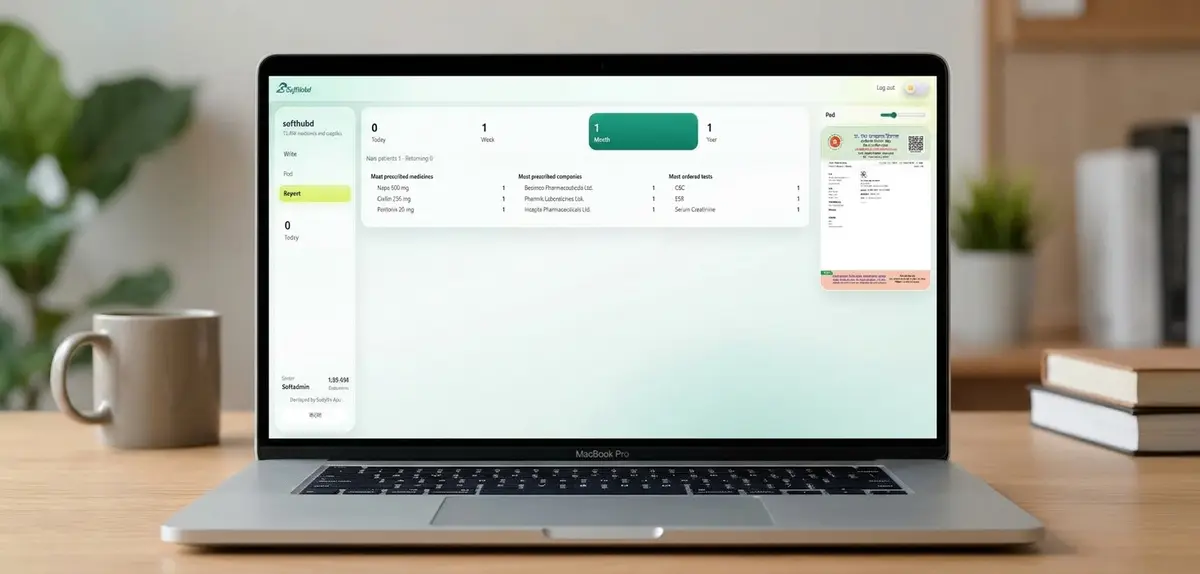
The report on softhubd is the prescriptions you saved. It is not a league table of Bangladesh, and it does not name a best company for the country. Open it and you see today, this week, this month, and this year, on Dhaka time. New patients and people who came back are counted apart. Under that are three lists: the medicines you wrote most, the companies on those rows, and the tests you wrote most.
A busy afternoon feels like everything. The list is the page after the feeling. If Napa is at the top, that is because you clicked Napa onto the pad, not because a catalogue voted. If one company sits above the others, that is the company printed on the rows you chose. Two bottles can share a name and still be different companies. The search row shows the company and the price so you can tell them apart before you click. The price stays off the printed page unless that chamber turns it on.

Which medicine you write most
The medicine list is the names that landed on the pad. A fever month will lift the same syrup. A skin month will lift a cream. That is the point of keeping the report. You can see the habit without opening a notebook and counting by hand. The software does not turn the habit into next week’s prescription. A line you use often can come forward as a suggestion. It sits on the pad only when you click. The report does not click for you.
Read it as your own shelf, not as advice. A name at the top is not proved safer, cheaper, or right for the next person. It is only frequent in the pages you already finished. If the top name surprises you, open a few of those visits and see whether you meant that strength. The report counts the row. It does not reopen the visit for you.
Which tests you write most
The test list is the investigation names you wrote, such as CBC or a urine test. It is not the laboratory’s result, and it is not a film. softhubd does not store a test result or a patient’s scan. It counts how often that name was written. If the same panel is on almost every page of the month, you can see that in one place. You still decide who needs it tomorrow. The count does not order the test, and it does not tell the lab anything.
That is still useful. A month of “the usual blood test” is easy to feel and hard to remember as a number. The report makes the number. You can ask whether the usual panel is still the one you want, or whether a quieter week would show a different list. The year view stops one crowded week from looking like the whole practice.
Which company shows up most
Company here means the company on the medicine row you chose. Doctors sometimes say a company was “referred”. On this page that means the same thing as written: the name that rode along with the bottle you picked. It is not a referral certificate, and it is not a letter to another doctor. There is a refer line on the prescription if you want to name a colleague. That line is not this report.
“Best” is the wrong word for the top of the list. The top company is the one that appeared most often in your saved pages. It can be there because the price in search was the one you recognised, because the strength was right, or because your hand goes to a familiar box. The report lets you see that familiarity. It does not award the company, and it does not hide the others. The price you used to choose the row stays off the patient’s paper unless that chamber has turned the price on.
What you gain by keeping the report
You stop rebuilding the month from memory. Today, the week, the month, and the year are separate, so a fever week does not pretend to be the year. New patients and returning patients stay apart, so a full chair is not confused with the same people coming back. The medicine list shows the bottles you actually wrote. The company list shows who made those rows. The test list shows the investigation names, not their results.
None of that chooses the next prescription. You still write. A suggestion waits for a click. The catalogue you search is about 72,000 medicines and supplies, which is larger than a 30,000 list, and a missing name can still be typed onto the pad. The report is the count of what you saved after those choices. Two free prescriptions on the demo, with a live print in a new tab, will only make a very small count. The shape is the same once the month has real pages: medicines, companies, and tests, on Dhaka time.
Does the report name the best medicine company in Bangladesh?
No. It counts the companies on the medicines you wrote in your own chamber.
Does it store test results or scans?
No. It counts the test names you wrote. Results and films are not kept here.
Will a frequent medicine add itself next time?
No. It can come forward as a suggestion. It sits on the pad only when you click.