
The visit is still yours to write
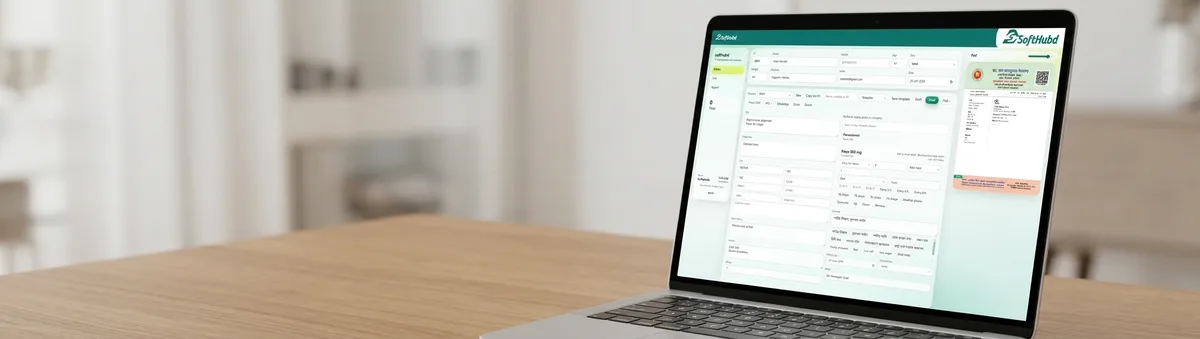
Doctor prescription software on softhubd starts where the visit starts. You write the chief complaint, the examination, the diagnosis, and the past history. You choose the medicine, name the test, and type the counsel. Nothing lands in those fields because a model has decided the patient needs it. Learning comes later, and only from pages already saved on this login.
Two doctors can hear the same complaint and reach for different bottles. The software keeps the habit of the login that saved the visit, so a separate login keeps the next afternoon as yours. Search beside that memory is a catalogue of about 72,000 medicines and supplies, and a missing name can still be typed onto the pad.
What has to be on the page before it can learn
A saved visit teaches when it has a complaint to match and something you wrote. The complaint can sit in the chief complaint, the past history, the diagnosis, or the examination. “Fever”, “cough for three days”, a diagnosis you spell the same way: the next visit can recognise those words. The same line counts. A longer line that starts with the shorter one counts too.
With those phrases the visit keeps the medicines on the pad, the test names, and the counsel, a handful of each, tied to that page. An empty page has nothing to offer later. The prescription you still have open does not teach itself. Suggestions come from earlier saved visits. The memory is the recent run of those visits, a few hundred of them, so the button follows the habit you are using now.
The second time is when a suggestion appears
One saved visit is a record you can open again. A medicine, a test, or a line of counsel is offered when that same item has been written at least twice on visits that match the problem in front of you.
When the match is strong enough you see up to three medicines, up to three tests, and up to three counsel lines. They are the ones you wrote most often on those visits. Temperature, pulse, heart rate, blood pressure, and weight do not throw a visit out. A closer match on those numbers lifts that visit’s lines. If you have only repeated one test, you see that test. The list is not borrowed from another clinic, and it never includes a brand you have never placed on a pad.
Fever with a cough, saved twice for a three-year-old with the same syrup and the same counsel, can offer those lines on the third child.
Age and sex keep a child and an adult apart
When the visit has an age, earlier visits have to sit in the same band: under one year, one to under five, five to under twelve, twelve to under eighteen, eighteen to under forty, forty to under sixty, and sixty and over. Months and days are turned into years first. A four-year-old visit does not lend its syrup to a forty-year-old visit. When sex is filled in, the earlier visit has to be the same sex. Leave age or sex blank and that part stays quiet. The complaint still has to match.
Weight counts as close within about three kilograms, or about fifteen percent when that gap is wider. Blood pressure, pulse, heart rate, and temperature are compared in broad ranges, low or high against ordinary. These numbers only decide which of your matching pages is read first.
At 100°F or above, or 37.8°C or above, a separate button searches for paracetamol. It does not place a tablet or choose the strength. You pick the row and the dose. Any learned buttons stay beside that search, still waiting for a click.
How the buttons help while the queue is moving
On a long afternoon the sentence is familiar and the catalogue is long. About 72,000 rows is a useful size for a strength you rarely use. It is a long scroll for the bottle you used yesterday and the day before. The button is that bottle, at the strength you saved, because you saved it twice on this kind of visit.
A test name that has been on two matching pages can be offered the same way. The software stores the name you wrote. It does not store a laboratory result, and it does not send the name to a lab. Counsel works the same way. A sentence about rest, food, water, or when to come back can return after you have used it twice. A month later you may remember the diagnosis and not the exact wording. You can ignore the button and type a fresh line. The button is a line you really wrote. Whether it fits the person in the chair is still your examination.
A click is the only way onto the pad
The pad stays as you left it until you click. That rule covers the medicine, the test, and the counsel. The software can show what you did before. The decision stays with the person who examined the patient.
A clicked medicine is added the way a search result is added. You can still change the dose, the duration, and the instruction before you print. A clicked test or counsel line is written into that field. If the field already has several lines, the new line follows them. The same text is not added twice.
Once the line is on the pad, it leaves the suggestion row. Nothing here changes a dose, orders a test, or prints on its own.
Keep the judgement with the examination
If the suggestion looks wrong, leave it and write the page you mean. After a few saves of the new habit, that habit is what the count shows. The learning follows your hand. This row does not check whether one drug clashes with another, and it does not name the disease from a code list.
The chamber report is a different page. It counts medicines, companies, and test names for today, the week, the month, and the year, on Dhaka time. The suggestion row cares about this complaint and this age, and it waits for a click. A frequent name in the report is only frequent in your pages.
Print, search, and the two free pages
You search when the suggestion is absent or wrong. Price can show in the search row so two bottles with one name stay distinct, and that price stays off the printed page unless the chamber has turned it on. You print on the pad you uploaded. A file for WhatsApp or email is something you attach yourself. The software does not send the message.
If the connection drops, work can continue for patients and medicines already opened on that computer, and saved work syncs when the connection returns. A fresh search of the full catalogue needs the connection. Learning can offer only what that doctor has already saved. It cannot see a visit that was never saved.
The demo is two prescriptions at no cost, with a live print, in a new tab. Two pages show the writing and the paper. A suggestion waits for the same choice on at least two saved visits that match, so the buttons appear once your own pages have that history.
Does this doctor prescription software add a medicine by itself?
No. It can show up to three medicines you already wrote on similar visits. The line sits on the pad only when you click.
When does a suggestion start?
After the same medicine, test, or counsel has been saved at least twice on visits that match the complaint, and the age and sex when those are filled in.
Will it suggest a drug I have never written?
No. The list comes from your own saved prescriptions. A missing name stays a search in the catalogue of about 72,000 medicines and supplies.
Does a high temperature choose the tablet?
No. At 100°F or 37.8°C and above, you get a search for paracetamol. You still pick the row and the dose.
Why did a suggestion disappear?
It left the row because that medicine, test, or counsel is already written on this visit. The offer is for what is still missing.