
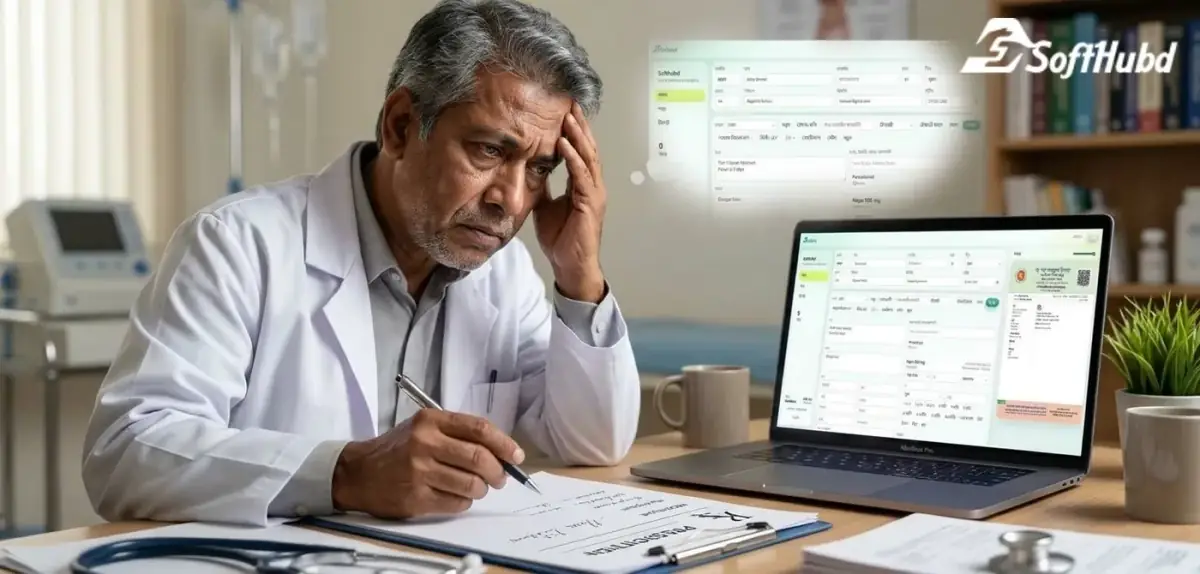
The pen stops
The complaint is on the paper. After food, five days, morning and night: the dose is in your head. The name of the bottle is not. The pen stays where it is. A name is late, and the page cannot leave until it is the name you meant.
That pause is when doctor prescription software is worth remembering. A list you can look at, and the lines you already wrote on afternoons like this one. softhubd is that list for a chamber in Bangladesh.
What the worry actually is
The worry is the wrong bottle. Two brands share a sound: a drop, a syrup, or a 500 mg tablet from a company you do not keep. A half-remembered name becomes the ink the mother carries. The counter has to finish the sentence you did not write.
You may have used this medicine all month. Today the strength slips. A paper pad has no row beside the name. You either remember, or you write something close and hope the pharmacy finishes your thought.
You are not forgetting medicine. You are forgetting one word, with a person waiting. Prescription software for doctors puts that word where your eye can check it before the paper leaves the room.
Two or three letters, then a row
On softhubd you type two or three letters. Search can start from the brand, the group, the company, or the supply. The row shows the group, the company, and the price, so a familiar name and the wrong strength sit apart. The price is for your eye. It stays off the print unless this chamber has turned it on.
About 72,000 medicines and supplies are in the catalogue. A syrup, a mask, gloves, a collar: a name in the list comes up the same way a tablet does. Click is the only way onto the pad. The page does not fill a regimen from the complaint, and it does not announce that two drugs clash. Read the row. Then decide.
If the name is missing, type it on. It is kept for the next search. The visit does not wait for a catalogue update while the patient is still in the chair.
When you remember the class, not the brand
Sometimes the brand is gone and the class is not. An antihistamine, the syrup you use for this cough, the company whose strip you trust: type that. The company column stops two bottles with one name from pretending to be the same bottle. The group column stops a drop and a tablet from looking like one choice.
A missing price is not a reason to skip a row. Choosing a row because the price looks familiar, when the strength is wrong, is the mistake the columns are there to show. You are not asking the page to invent a treatment. You are asking it to show the name you cannot quite say.
The name you wrote last week
Search helps when a fragment of the name is still in your mouth. The other help is quieter. It is your own page coming back.
When the same medicine has been saved at least twice on visits that match the complaint in front of you, doctor prescription software can offer up to three of those medicines. Tests and counsel follow the same rule, up to three each. The list is not borrowed from another clinic. A brand you have never placed on a pad does not appear there. If you have only repeated one test, you see that test.
When the visit has an age, a child’s saved syrup does not transfer to an adult. Sex, if you filled it in, has to match. Pulse, weight, and temperature do not throw a visit out. A closer match lifts that page. At 100°F or 37.8°C and above, a button searches for paracetamol. It does not choose the tablet. You still pick the row and the dose.
One saved visit is a record you can open again. A suggestion waits until the same choice has been on two matching pages. The first afternoon does not teach the next button. The second one can.
Open yesterday, if yesterday had the name
There is another way through the same pause. You may not remember the brand. You do remember the child. She came last Tuesday. Open that visit by name, by mobile, or by the ID, a number such as 0042. The mobile is kept for lookup. It is not printed on the pad.
Yesterday’s page is still yesterday’s page. You can copy it into today’s visit when you want that bottle in front of you. Then you change what changed. Copy is not a search. Copy brings the lines you already signed. Search brings one row from the catalogue. Both wait for you. Neither one writes the visit while you are still thinking.
A separate login keeps the suggestion list as your habit. One shared password mixes two people’s bottles into one row.
The dose is still your sentence
The click puts the name on the pad. Morning to night, every few hours, or drops per minute, and how many days: that sentence is still yours. Banglish can become Bangla. A wrong row can come off. The second click is the one that should leave the room.
The patient needs the bottle you meant, in letters a pharmacy can read at nine in the evening. If you would not say the dose out loud in that wording, do not print it.
The paper they take home
Print on the pad you already use. Upload that PDF or photo, A4, A5, or pad size, and set the edge in millimetres so the writing misses the logo. Each chamber keeps its own file. A clear seal stays clear.
If the patient has left, make a JPG or PDF and attach it yourself. The software does not open WhatsApp and does not send a text. A photo of unsure handwriting does not repair the name. The letters have to be the ones you chose while the row was in front of you.
When the connection drops
Patients and medicines already opened on that computer stay usable if the internet stops. Saves go up when the line returns. A fresh search of the full catalogue needs the connection. Suggestions can offer only what this login has saved.
At dusk, the names you used this week are the ones you can still reach. A strength you have never opened waits for the network.
What you are not buying in that minute
softhubd does not diagnose, and it does not call itself the best. SMS, a queue board, voice, and an ICD list are not in the pack. A larger month adds chambers and saved prescriptions. It does not add a sender.
Basic is ৳1,000 for 500 saves and 2 chambers. Standard is ৳2,000, 1,000 saves, 5 chambers. Premium is ৳3,000, 2,000 saves, 10 chambers. One doctor. Unused saves stay. The buy-once price is spoken on the demo, not printed here.
The demo is two prescriptions, in a new tab. Write the name that slipped. Look at the company. Click only the row you meant.
Does this prescription software remember the medicine for me?
It can show names you already saved on similar visits, up to three, after the same choice has been saved twice. A name you have never written stays a search in the catalogue. Nothing sits on the pad until you click.
What if I only remember the company or the group?
Search by that. The row shows the group, the company, and the price so you can tell two similar bottles apart. The price stays off the print unless that chamber turns it on.
Will a high fever choose the tablet?
No. At 100°F or 37.8°C and above, the page offers a search for paracetamol. You pick the row and you write the dose.
Can I open last week’s prescription if the brand will not come?
Yes. Open the visit by name, mobile, or an ID such as 0042, and copy it only if today’s examination still wants that page. Then change what changed.
Does doctor prescription software in Bangladesh send the prescription by itself?
No. You print on your own pad, or you make a JPG or PDF and attach it yourself. The demo is two free prescriptions at soft.softhubd.com.