
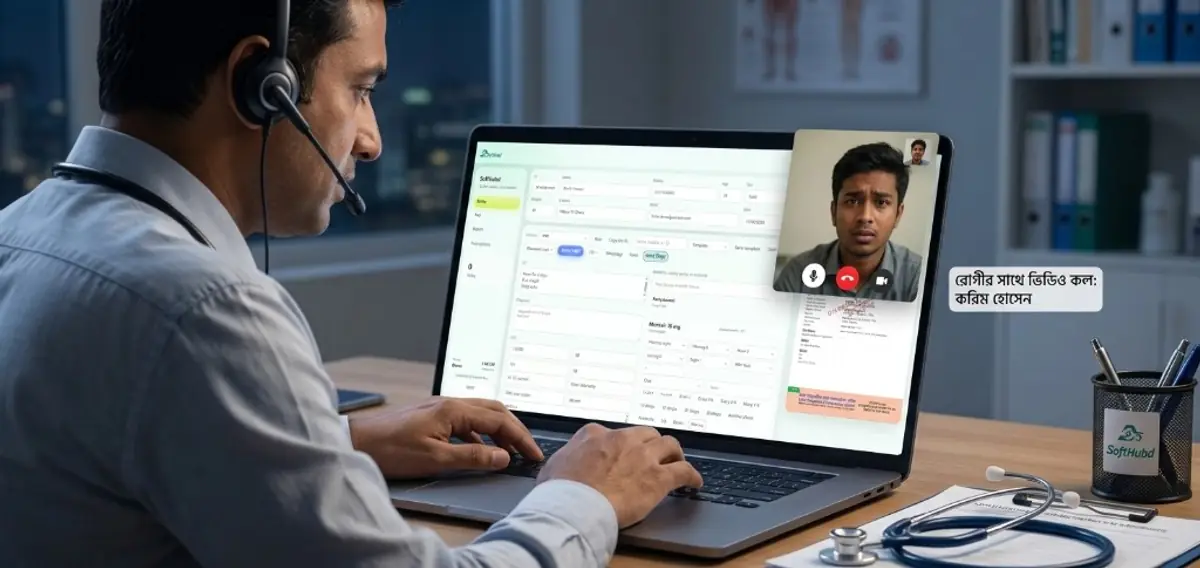
The call is on the laptop. The prescription is on softhubd
An online visit does not remove the need for a clear page. The patient is on a video call — WhatsApp, Zoom, or another app you already use. Beside that window, or on the same screen, softhubd is open. You hear the complaint, you look at the face, and you write the visit the same way you write in a chamber: chief complaint, examination notes, medicines, tests, and counsel. When the call ends, the patient does not leave with a half-remembered dose typed into a chat. They leave with a JPG or a PDF of your own pad, the one you would have printed if they had been in the room.
softhubd is prescription software for a doctor’s chamber in Bangladesh. It does not host the video call. It does not diagnose. Nothing sits on the pad until you click. That separation matters online. The call is the conversation. The software is the page. Confusing the two is how a dose becomes a short message that a pharmacy cannot trust.
This article is for the afternoon when the patient cannot travel, the evening when a follow-up fits a screen better than a waiting room, and the week when one chamber is quiet but the phone still rings. The tools are the ones already on the product: your pad file, medicine search of about 72,000 rows, Bangla and English, saved visits with an ID such as 0042, and a file you attach yourself. No SMS. No automatic sender. No voice that fills the prescription for you.
How an online visit actually runs on one screen
Keep the video app where you can see the patient. Keep softhubd where you write. On a laptop that often means the call on one side and the writing page on the other. You type the name, age, and sex. Mobile stays for lookup later; it is not printed on the paper. The address and weight go in if you need them. Then you write what you heard: fever for three days, dry cough, body ache — in English or in Bangla. Instructions on the page stay Bangla by default if that is how you set them. For other fields, turn on বাংলা লিখুন when you want Banglish to become Bangla. If you leave that button off, Bangla typing does not run. That is deliberate, so English notes stay English while you talk.
Search for the medicine while the patient is still on the call. Group, company, and price show in the search row so you do not click the wrong strength. Those three stay off the print unless that chamber has turned them on. About 72,000 medicines and supplies are in the catalogue. A missing name can be typed onto the pad and kept for the next search. If the temperature is 100 or higher, the page may mention a Paracetamol search. It does not add the row. You still search, click, and write the dose and the days.
When the same complaint has been saved more than once on matching visits, softhubd can offer a few of the medicines, tests, and counsel lines you already chose. Up to two or three suggestions, from your own pages, not from another clinic. Click is still required. Online work is faster when yesterday’s cough regimen is one click away, and safer when the page refuses to invent a regimen from the video alone.
The pad on the call should look like the pad in the chamber
Upload the pad you already use: a PDF or a photo, A4, A5, or the pad’s own size, with margins in millimetres. Each chamber has its own file. Online patients recognise the letterhead they saw last month in the room. A plain chat message drops the seal. The JPG or PDF keeps the laid-out page: doctor name, degree, hospital line, medicines, Bangla dose, tests, and counsel. If the seal is a clear PNG, it stays clear in the file.
Before you share, open the fullscreen pad view if you need a larger look. Zoom if a line is tight. Then mark the visit final only when you have read it. A draft shared by mistake is how the wrong dose reaches a pharmacy from a good video call. softhubd makes the file. It does not open WhatsApp, it does not pick the chat, and it does not send the message. On a phone you use the share sheet. On a computer the file downloads and you attach it in the same call thread or in a new message. If you skip that step, nothing has been sent. That rule is the same for email. There is no scheduled mailbox inside softhubd.
What stays on your computer when the line drops
Online visits depend on the network for the call. The writing page is kinder. Patients and medicines already opened on that computer stay usable offline. Saves go up when the connection returns. Reports use Dhaka time, so today’s count and this week’s count match the clock you use in Bangladesh, not a server in another zone. If the video freezes for a minute, you can still finish the dose line and save. When the call returns, you already have the page.
Returning patients are easier online when you can open the last visit by name, mobile, or visit ID. Copy last Rx if it helps, then change what changed. The photo they still have in their gallery is yesterday’s file. Editing today’s visit does not rewrite that picture. Make a new JPG or PDF and send that one if they need the new page in hand.
Chambers, language, and the end of the day
A monthly pack is one doctor. Name and degree must match closely enough for that doctor’s chambers to open. Basic is ৳1,000 for 500 saved prescriptions and 2 chambers. Standard is ৳2,000 for 1,000 prescriptions and 5 chambers. Premium is ৳3,000 for 2,000 prescriptions and 10 chambers. Unused saves stay. Buy 500, use 200, and 300 remain; another 500 makes 800. Buying once covers up to 5 doctors and 10 chambers; that price is asked on the demo, not invented in this article. Domain and hosting are separate. The licence turns on after payment is seen.
Bangla and English are both in every pack. An online chamber that writes Bangla doses for the pharmacy and English notes for the file can do both on the same visit. The report at the end of the day still shows how many prescriptions you saved, which medicines you wrote most, and which tests came up — useful when half the week was video and half was the waiting room.
Try the writing before you promise the call
Two free prescriptions on the demo are enough to rehearse the path: write a sample visit, print or make a file, and see whether the pad looks like yours. The demo opens in a new tab at soft.softhubd.com with ?demo=1. If the page feels right with a quiet room and a headset, it will feel the same when the patient is on the other side of the screen. softhubd will not replace the judgment of the call. It will hold the page so the call does not have to.
Does softhubd include a video call?
No. You use WhatsApp, Zoom, or another call app. softhubd is where you write and save the prescription.
How does the patient get the prescription after an online visit?
softhubd makes a JPG or PDF of your pad. You attach that file in the chat or in email. It does not send the message for you.
Can I write Bangla doses while I speak English on the call?
Yes. Turn on বাংলা লিখুন when you want Banglish to become Bangla. Instructions can stay Bangla by default.
Will a medicine be added automatically from the video?
No. Nothing sits on the pad until you click. A fever of 100 or more may mention a Paracetamol search. It does not add the row.
What if the internet drops while I am writing?
Patients and medicines already opened on that computer stay usable. Saves go up when the connection returns.